Quarry Crushing Plant Design Overview
Designing a quarry crushing plant requires careful planning from the quarry face to the final product stockpile. A well-designed plant ensures consistent product quality, efficient operation, and minimal downtime. This step-by-step guide covers the essential considerations for aggregate plant design.
Step 1: Site Assessment and Geology
Before designing the plant, understand the deposit:
- Rock type: Hardness, abrasiveness, mineral composition
- Fracture patterns: Affect blast design and fragmentation
- Overburden depth: Affects stripping cost and plant feed quality
- Groundwater: Affects plant foundation and washing requirements
- Topography: Affects plant layout and material flow
Step 2: Production Requirements
Define your production targets:
- Daily/weekly/monthly tonnage requirements
- Product specifications (gradation, shape, cleanliness)
- Products needed (size fractions)
- Operating hours and shifts
Step 3: Blast Design for Crushing
Good blasting is the foundation of efficient crushing:
- Design blast pattern to achieve consistent fragmentation
- Target fragment size: 80% passing primary crusher feed opening
- Control fines generation — excess fines waste energy in crushing
- Consider pre-splitting for clean final walls
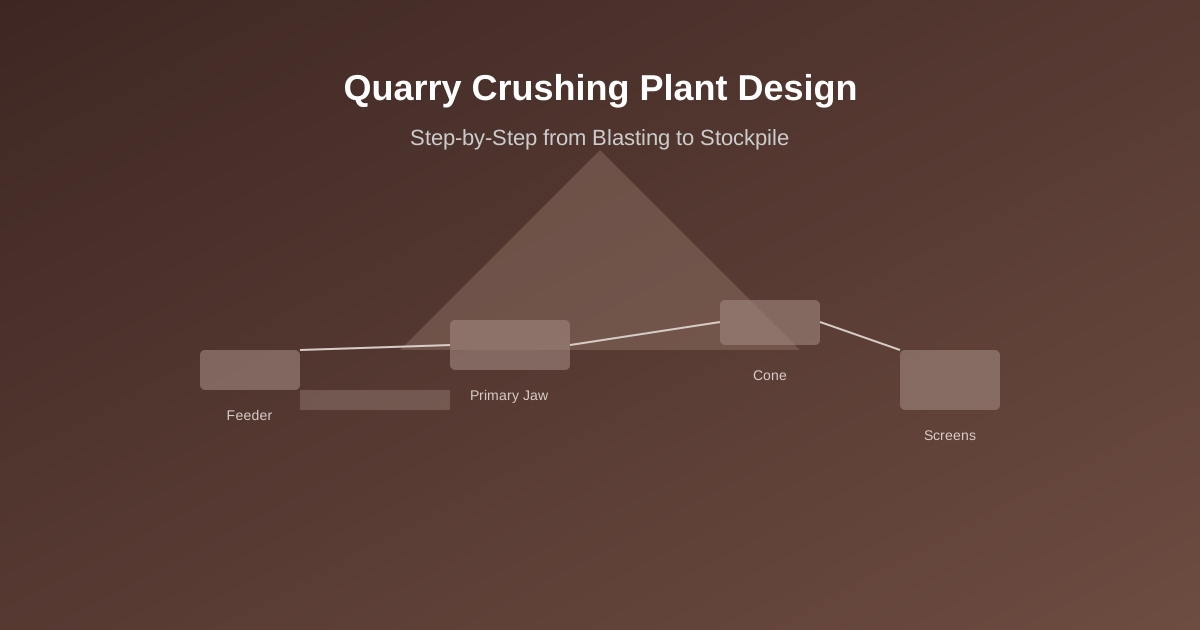
Quarry Crushing Plant Design — Step by Step
Step 4: Primary Crushing Selection
Choose primary crusher based on feed size and capacity:
Jaw Crusher: Best for hard, abrasive rock. Simple operation. Typical for most quarries.
Impact Crusher: Best for limestone and softer rock. Higher reduction ratio but more wear.
Gyratory Crusher: Very high capacity operations (>2,000 tph). Higher capital cost.
Step 5: Secondary and Tertiary Crushing
Standard Configurations:
- Hard rock (granite, basalt): Jaw → Cone → Cone + VSI for shaping
- Limestone: Impact → VSI + Screen
- Gravel: Screen + Cone (if needed)
Step 6: Screening Circuit Design
Screens determine product quality. Key design decisions:
- Single-deck vs multi-deck screens for multi-product plants
- Dry screening for clean, dry materials
- Wet screening when washing is required
- Screen media selection based on moisture and abrasiveness
Step 7: Conveying and Material Handling
- Design conveyor routes for shortest material travel
- Include surge bins between crushing stages
- Use variable-speed feeders for controlled feed
- Design transfer points to minimize dust and spillage
Step 8: Stockpile Management
- Radial stackers for large stockpiles and product blending
- Reclaim tunnels for load-out flexibility
- Segregation management through stockpile layering
WSHT provides complete quarry plant design services, from concept studies to detailed engineering. Contact us for assistance with your quarry development project.